
Investments to expand the coverage and improve the management of water and sanitation systems, in order to ensure the efficient use of water resources in the medium and long term, as well as to guarantee the overall sustainability of services.
Otros programas asociados:
- LAIF Bolivia-LA/2017/390-223: Support to the Water and Sewerage Programme in Urban and Peri-Urban Areas
- DCI/LA/2019/410-047: Integrated Water Management in Urban Areas Programme
- Acuerdo de contribución con Blending Nº 700002477- Water and sanitation programme for rural communities, small and intermediate cities
Bolivia
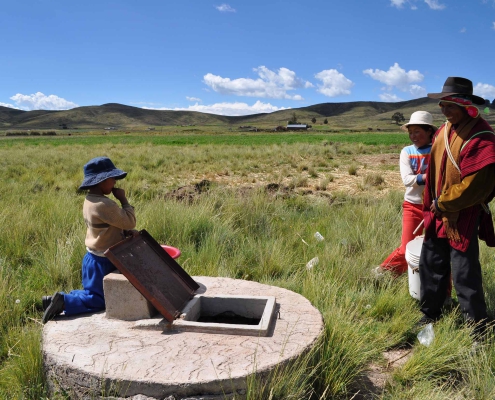
As of December 2024, the Fund maintains three programmes in Bolivia, all of which are part of larger global operations involving the European Union and other funders such as the Inter-American Development Bank (IDB). Thus, it is possible to implement initiatives of greater impact and far-reaching scope, which allow progress towards the universal access to drinking water and sanitation services in rural, urban and peri-urban areas and the overall strengthening of the sector and the beneficiary institutions. The progress made during the year is detailed below.
The BOL-006-B programme: Support to the Urban and Peri-Urban Water and Sewerage Programme (APAAP) has a financing of €5 million and is part of a global programme of the same name involving the European Union, the IDB and the Ministry of Environment and Water (MMAyA), which aims to achieve sustainable water and sanitation services by driving the progressive compliance with the human rights to water and sanitation through the balance of environmental sustainability, economic growth and climate change adaptation.
In 2024, the project for construction of interconnections between the intake works and the treatment plant for the drinking water system in the city of Cobija, which started the commissioning phase at the end of the year, benefiting 963 households, was started and implemented.
Significant progress has also been made in the implementation of the project for construction and extension of the drinking water network for the communities of Chicani and Chinchaya, phase II, as well as the sanitary sewerage system, the conclusion and commissioning are pending for the beginning of the year 2025. Likewise, work has continued on the preparation of the Master Plan for drinking water, sanitation and stormwater drainage in the city of Trinidad, this project will be completed in the first quarter of 2025.
Work was also contracted for the elaboration of two Plans: the Updating of the Metropolitan Master Plan for drinking water, sanitation and stormwater drainage in the metropolitan area of La Paz and the Drought Master Plan for service operators in Tarija, Cochabamba, Sucre and Yacuiba. As a result, 97% of the funds foreseen in the programme’s Procurement Plan.
On the other hand, the BOL-007-B Programme, called Integrated Water Management in Urban Areas (GIAAU), is also part of a global initiative involving the EU, the IDB, FONPRODE and the FCAS, and is implemented by the MMAyA.
This is an initiative that aims to respond to supply restrictions and coverage deficits in various cities, through the management of water resources, access to services and the strengthening of operators. To this end, strategic actions and guidelines will be established following the guidelines of the Metropolitan Master Plans financed in the Peri-Urban Water and Sewerage Programme Phase I (PAAP I) -with support from AECID-IDB-, as well as those carried out in PAAP II with IDB financing.
At the same time, this programme also includes the integrated water management in urban areas, covering the conveyance and treatment of effluents and identifying priority interventions to ensure the supply of drinking water and the adequate management of wastewater, including actions that allow EPSAS (public social water and sanitation company) to soften drought events.
It is also planned to carry out evaluations and updates of these Master Plans, specifically in aspects referring to the updating of supply and demand balances and the integrated management of water resources, considering the complete water cycle, from sources to conveyance and the adequate treatment of wastewater, under a climate change adaptation approach.
In 2024, the consultancy for the Strengthening of the hydrometeorological monitoring system for reservoirs in Bolivia (SIMHEB) was tendered, contracted and started. SIMHEB is an IT platform for data visualisation that provides real-time information and data for planning. The strengthening work consists of: a) providing missing information through the incorporation of monitoring networks that were not included; b) developing a strategy for the correct incorporation of this information; and c) systematising operational plans, promoting coordination between the ministry and the operating entities.
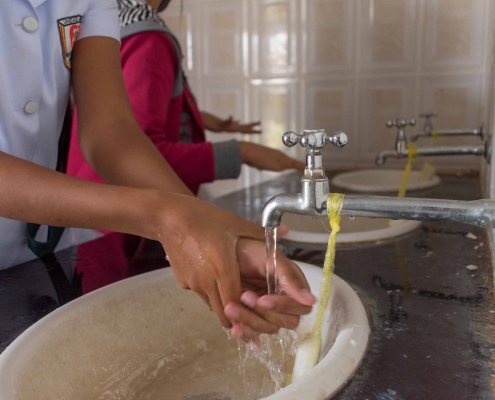
In addition, work continued on the consultancy project for the Strengthening of water availability and demand monitoring systems within the framework of the National Drought Monitor, which is working in Tarija, Sucre and Chiquitanía. Finally, this year the third main activity of the programme was tendered for the third time, the study for the Strengthening of the Bolivian Groundwater Information System (SIASBO). This consultancy will provide information for the work of constructing and refurbishing wells, as well as equipping monitoring networks in aquifers.
Finally, the Water and Sanitation Programme for Rural Communities, Small and Intermediate Cities (BOL-009-B) was approved by the Council of Ministers in December 2023 and during 2024 work has been done to put in place the operational documents and the detailed planning necessary to start implementation. It is a €3.57 million initiative to be implemented by the MMAyA.
This action, which will focus on small rural communities (less than 2,000 inhabitants) and cities under 20,000 inhabitants, will work towards the implementation of systems that are resilient to extreme events – exacerbated by climate change – and associated risk management. The objectives are, on the one hand, to provide access to drinking water supply, sanitation and hygiene services that are sustainable and resilient to climate change. On the other hand, work will be done to strengthen water and sanitation operators (Water Committees and Water and Sanitation Service Providers -EPSAS-) in the communities and beneficiary populations, as well as the capacities of sectoral actors at the central, departmental and municipal levels.
This programme will work in tandem with a larger initiative involving the European Union, through the Latin America and Caribbean Investment Facility (LACIF) -financed by AECID-, and a loan from the IDB, totalling €85.37 million.
The specific contribution of the FCAS will focus on Component I, focusing on infrastructure works and support to the integrated management of services. In this line, the following actions will be financed:
In addition, the rest of the intervention will include other aspects, such as planning and pre-investment studies –with the aim of having suitable projects for future phases and taking into account climate change considerations.

