
LAIF Ecuador. LA/2020/417-023 Sustainable drinking water and sanitation for the rural population of Portoviejo Canton, Province of Manabí, Ecuador. (ECU-LAIF-083)
Combined delegated cooperation and reimbursable cooperation operation.
In the Canton of Portoviejo, the Municipality (GADMP) is implementing a major programme (called the Triple AAA Plan) to improve access to water and sanitation for the rural population. To carry out this project, a broad partnership of donors has been formed, in which Spanish Cooperation has an important participation through three mechanisms (LACIF-EU delegated funds, reimbursable financing from FONPRODE and a grant from the Water Fund through the drinking water and sanitation programme in scattered rural communities in the Portoviejo Canton, Province of Manabí). The Triple AAA Plan aims to establish a large 47-kilometre drinking water and sewerage system along Rio Chico and small projects to serve scattered rural areas that cannot be connected to the general system.
The total operation combines a variety of funding and grants. On the one hand, there is the Base Project (BP), based on credits and loans for the construction of the large drinking water system, and on the other hand, the Scattered Zones Project (SZP), specifically to extend the benefits to scattered rural populations, which is financed by AECID through the FCAS and the EU through LACIF funds, managed by Spanish Cooperation.
The distribution of funds is as follows: three credit operations between the European Investment Bank (EIB), (€54.44 M), FONPRODE (€15.45 M), the IDB (€25 M) and the Municipal Decentralised Autonomous Government (GADM) of Portoviejo, and an additional contributions made up of grants from FCAS-AECID (€3,3 M), the LACIF project (€10 M) and contributions from the GADM of Portoviejo, with the aim of providing drinking water and sanitation to dispersed rural communities and offering comprehensive support for the implementation of the Base Project.
The programme involves important social and environmental actions, with a community development component to ensure the participation of the target population in all phases of the programme, in order to achieve the sustainability of the systems.
During 2024, the Triple AAA Plan has worked through the GADMP to execute 7 exploratory wells that are expected to supply five drinking water systems. For this purpose, studies and designs will be carried out prior to the procurement of the work, which is expected to begin at the end of 2025 and, in parallel to the formation and strengthening of the Drinking Water and Sanitation Administration Boards (JAAPS). This process incorporates all the lessons learned from the FCAS ECU 51 B programme for scattered rural communities in Portoviejo, a predecessor in scope and sector to the application of LACIF funds.
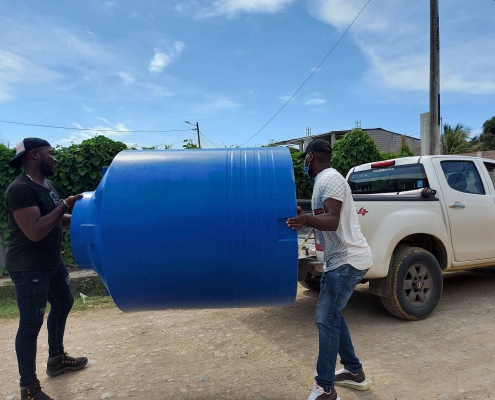
Likewise, through the Ecuadorian NGO Fondo Ecuatoriano Popolorum Progressio (FEPP), hygiene and sanitation improvements have been carried out in selected homes in the communities based on a socio-economic vulnerability study, 62 Family Technical Files have been prepared and hygiene and sanitation interventions have been implemented, with connections to the drinking water and/or sanitation network, as well as the rehabilitation and construction of bathrooms and kitchens.
On the other hand, FEPP has implemented Integrated Water Resource Management (IWRM) actions in the territory through the preparation of studies and the implementation of forestation and reforestation actions of up to 8.4 hectares through demonstration plots and planting for stabilisation of slopes and riverbanks, as well as specific infrastructure actions for the stabilisation of areas subject to intervention or for the recovery of natural watercourses.
Finally, an addendum to the Contribution Agreement between the EU and AECID (for the delegated cooperation programme) has been approved, which has enabled the Programme’s term to be extended by 36 months and thus to be brought into line with the actions of the other partners, facilitating the management and technical assistance work to be carried out with these funds until the full implementation of all partners.

