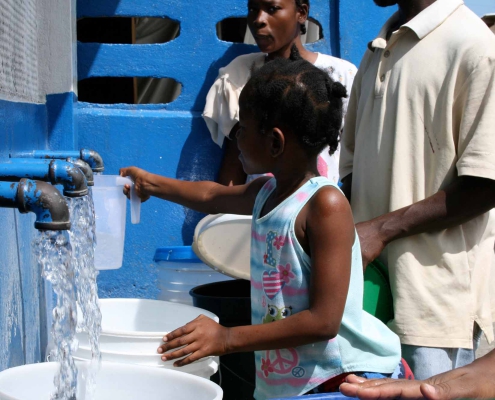
URBAYITI: Access to basic water and sanitation services
This programme has a total funding of €4 million, of which €1 million corresponds to a grant from Spain, through the Water Fund, and €3 million corresponds to EU delegated funds.
URBAYITI is based on the principle of donor coordination and Spain was chosen to manage the project because it is one of the main donors to the water and sanitation sector in the country, generating a close relationship with the National Directorate of Drinking Water and Sanitation (DINEPA) of the state.
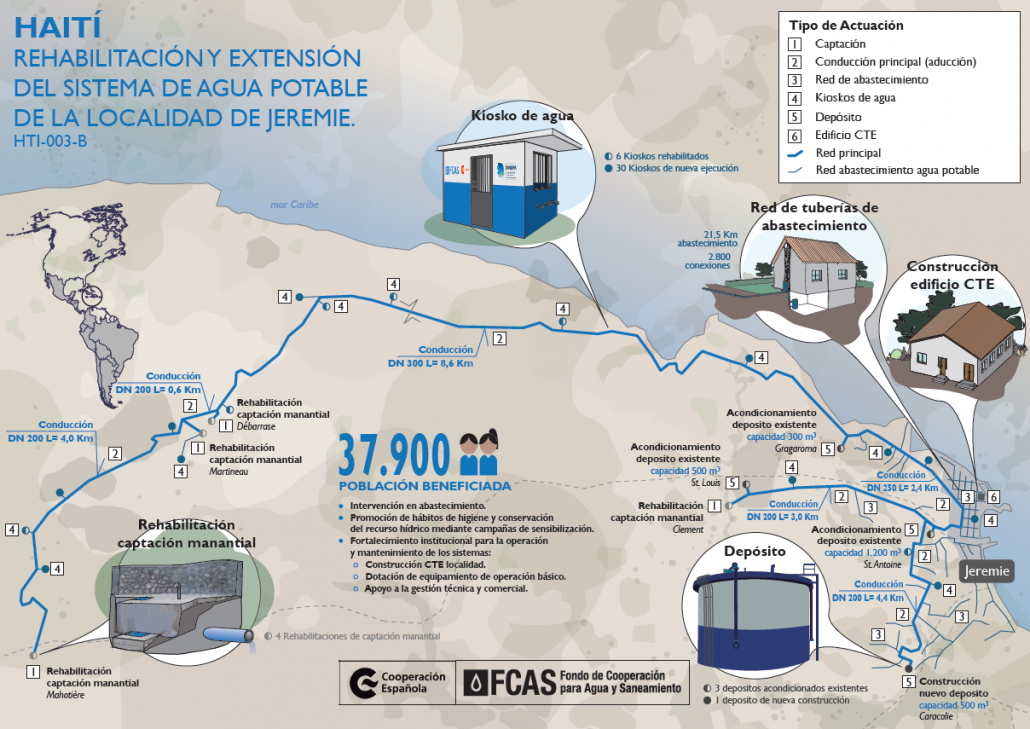
The goal is to strengthen the resilience of cities and urban populations by improving access to basic services and creating the conditions for water supply and sanitation compatible with the integrated development approach in the area. In particular, work is being done to improve access to basic services in the cities of Port-au-Prince, Jérémie and Les Cayes.
Project activities are concentrated in the cities of Jérémie and Les Cayes and to a lesser extent in the Port-au-Prince metropolitan area. The intervention is expected to facilitate access to water for 22,500 people in Les Cayes and 2,640 in Jérémie, thanks to the rehabilitation of the Savane reservoir, the rehabilitation and extension of the existing secondary networks, and the implementation of the condominium system in Les Cayes. The implementation of a condominium drinking water system represents a major innovation, inspired by the Brazilian model of the 1980s. This system, adapted to densely populated and economically disadvantaged urban areas, treats each group of households as a single entity, connected to a main drinking water network, and promotes a social and community approach.
Regarding sanitation, seven sanitation blocks are planned for construction in public spaces in Port-au-Prince. In addition, the management of the wastewater treatment service in Les Cayes will be strengthened. The project also includes social engineering actions and strengthening the management, use and maintenance of the systems.
In 2024, the main progress has been made in signing and starting the performance of remaining works, as well as the establishment of protocols for the management of the sanitary blocks