
Promoting integrated water resource management, guaranteeing their protection and preservation.
Other associated programmes:
- There are no other associated programmes.
Panama
PAN-009-B: Drinking water and sanitation programme in rural and indigenous areas of Panama with a focus on local management.
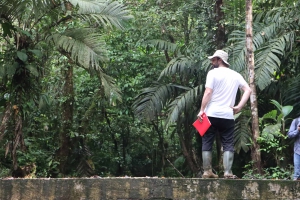
Two programmes are currently underway in Panama. The first one, called Drinking water and sanitation programme in rural and indigenous areas of Panama, with a focus on local management, aims to increase access and quality in the provision of drinking water and sanitation services in rural and indigenous areas of the country.
The area of intervention is the Ngäbe-Buglé region, located in the northwest of the country, which has a largely indigenous population and high levels of poverty. The specific areas of operation are rural and scattered, remote and difficult to access, especially during the rainy season, which poses an additional challenge for the implementation of services. This has led to the extension of the programme on several occasions, with final completion scheduled for December 2025.
The total amount of the initiative is €10.35 million, of which 50% is a grant from the FCAS and the other 50% from the Government of Panama. It is estimated that, once all actions are completed, the programme will benefit around 5,900 people.
During 2024, work has been carried out on the performance of the works contracts for the Kankintu District. Of the three ongoing interventions, the Guayabito project, which has provided services to 154 families, was completed in February 2024. On the other hand, the actions in Becativí-Morodoni (Nutiví Occidente) and Gobrante (in Nutiví Centro) are still underway. However, the infrastructure actions are behind schedule and work is ongoing with the Panamanian authorities to ensure that they take the necessary steps to complete all the work before the end of the intervention
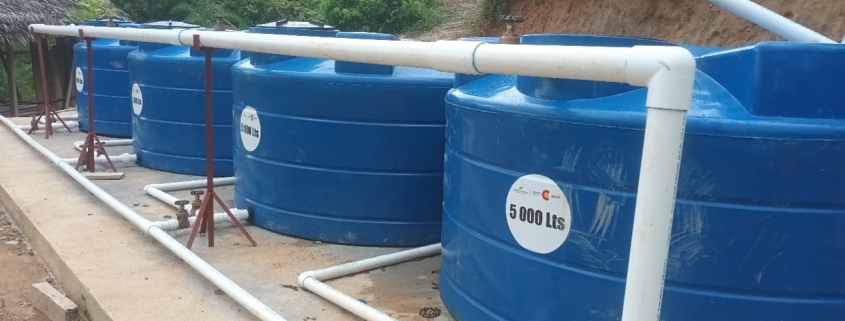
Storage tank system in Guayabito
The programme has also promoted institutional strengthening and reinforced sustainability in the provision of water and sanitation services. In this regard, work continues with the Rural Aqueduct Administration Boards (JAARs), which are responsible for the management of the services, in legal and administrative, management and operational aspects. In Panama, the JAARs are formed with personnel from the communities, and are jointly responsible with the Panamanian State for the administration, operation, maintenance and expansion of rural drinking water supply systems, by virtue of Executive Decree No. 1839/2014 [Decreto Ejecutivo nº1839/2014].
In addition, community awareness-raising activities have been carried out in various communities on issues related to water care and management
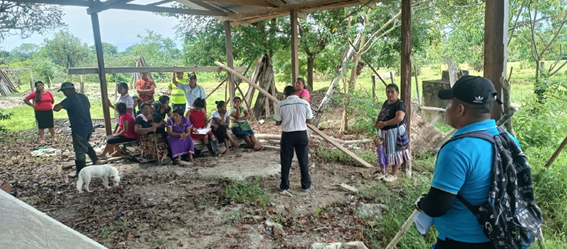
Community awareness-raising actions in Kankintu District
 Water and Sanitation Information System) for the communities of the Ngäbe-Buglé region, which is being carried out within the framework of the programme, reaching a total of 237 communities by 2024. Global SIASAR is a joint initiative initiated by the governments of Honduras, Nicaragua and Panama that has subsequently been extended to other regions. The objective is to have a basic, updated and verified information tool on the existing rural water supply and sanitation services in a country, which facilitates the planning and prioritisation of interventions.
PAN-010-B: Participatory development and dissemination of the National Guide for the selection of wastewater treatment technologies.
The PAN-010-B programme, for the participatory development and dissemination of the National Guide for the selection of wastewater treatment technologies, is an institutional strengthening initiative that aims to contribute to the implementation of the National Drinking Water and Sanitation Policy for the Republic of Panama, through two specific objectives:
This is a strategic, nationwide programme with a total in-kind contribution of €250,000 (50/50 between the Government of Panama and the FCAS). The implementing entity is the Ministry of Health (MINSA) of Panama and throughout 2024 work has continued on the preparation of the chapters of the Guide, obtaining preliminary drafts thereof at the end of this year. These are under review by a technical team made up of staff from different Panamanian institutions (such as the Ministry of Health, the Institute of National Aqueducts and Sewerage, the Panamanian Sanitation Programme, the Ministry of Environment, the Comptroller’s Office, and other institutions with sectoral responsibilities). Technical assistance for this work was provided by the Centre for Public Works Studies and Experimentation (CEDEX). Progress is validated in joint missions of the consulting team and CEDEX staff, through meetings of the National Inter-Institutional Committee for Drinking Water and Sanitary Sewerage (CIAPAS), created as a coordination mechanism with other governmental entities or non-governmental organisations involved in the promotion, financing or construction of drinking water supply and sanitary sewerage systems, pursuant to Executive Decree No. 441/2008 [Decreto Ejecutivo nº 441/2008].
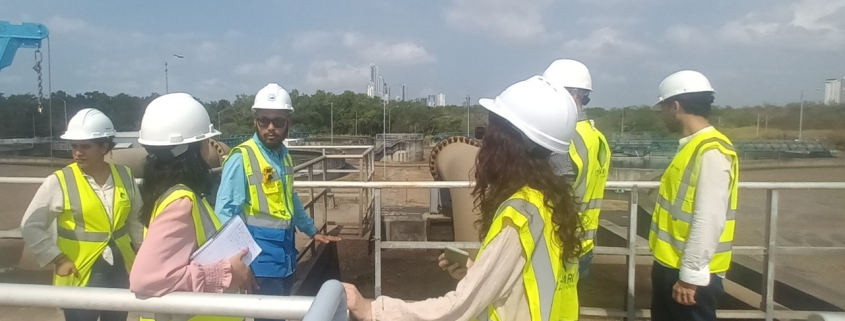
Visit to the «Juan Díaz» Wastewater Treatment Plant in Panama City
Related information
Infographics on programmes in the country
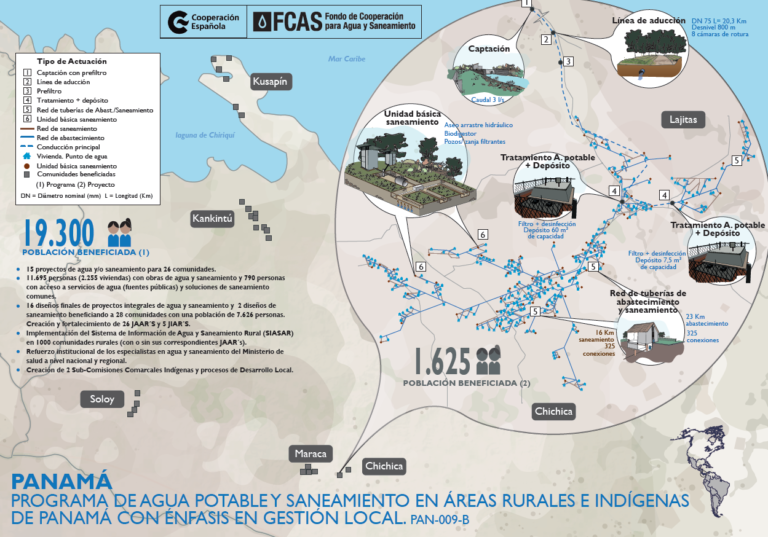
These infographics visually show some of the specific interventions and projects developed within the framework of the programmes..

